
New Product Release Data Sheet
SMT NC-400 ENTRY LEVEL NANO COATING SYSTEM
The SMT NC-400 Nano Coating unit is an entry level system designed for low volume, manual coating operations on products requiring environmental using new generation Nano particle Fluoro-Polymer resin systems. It supports all the necessary parameters to maintain the material within the machine correctly, whilst reducing parasitic losses over extended periods. The NC-400 features a dipping tank with a refrigerated sump. Coating material is continuously re circulated through multi stage filters and a unique SMT developed solid state refrigeration system to reduce evaporation losses. Unlike conventional refrigeration systems which are subject to failure and refrigerent losses, the SMT solid state system can tolerate failure of part of the cooling array and continue working, saving both lost production time and expensive coating materials. Losses are further reduced by dual cooling coils in the hold zone above the sump, minimizing loss to the normal evaporation of the carrier solvent as the coated objects dry outside the machine. The dipping operation is manually carried out by the operator, but optional automated dipping will be available later. Control is by PID digital temperature controls with visual and audible alarms for all process critical parameters. An advanced system with computer control designed for automated dipping and integration into a process line will be available early 2017. The NC-400 works with almost all current Fluoro-Polymer coating materials from a variety of manufacturers.

Fluoropolymer Nano-coating Technical Data Sheet

The LT-4 Nano-coating is a low-cost, high-performance fluoropolymer dissolved in a cost effective solvents.
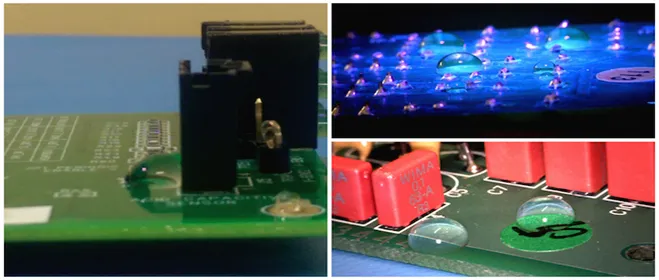
The LT-4 when applied to products exhibits superior hydrophobic (water repellent) and oleophobic (oil repellent) properties at a sub micron level.
Designed for protection of high quality products like printed circuit boards (PCBs) LT4 will protect a board and the electronic components from moisture, water, condensation and corrosion.
LT-4 also excels in preventing damage from solvents and other chemicals.
The LT-4 material can be applied to printed circuit boards (PCBs) and other electronic devices without the need for masking when applied at 1-2 um film thickness.
The LT-4 coating can be applied via spray, dip or brush. The coating can be cured in air or accelerated via oven bake. The material can be supplied with a UV trace added to aid inspection
Features
- Highly repellent to liquid (hydrophobic) and oil (oleophobic)
- Resistant to solvents and chemicals
- Dries extremely quickly at room temperature
- Possible to apply coating without masking critical components
- Wide temperature range performance
- High dielectric strength material
- Easily inspected with a UV trace
- Products certified to IPX5, IPX7
- Easy to apply by spray and dip methods
- Customizable chemistry
- Survives Gamma and E-beam exposure
NANO COATING MATERIAL (น้ำยานาโนเคลือบงานPCB) 3

Liquid Color and clarity: Slightly cloudy to clear
Properties Odor: Similar to acetone
Content/Concentration: 1.0- 2.0 wt%
Viscosity: Varies with concentration of solids
Solubility: In hydrocarbon solvents
Flammability: Flammable
Environmental: Low in toxicity, non-ozone depleting (dry state)
Toxicity rating: Non-toxic (dry film state)
Electrical Dielectric Breakdown Strength: 1000 V/mil
Properties Dielectric Constant [at 30% RH]: 3.0 (at 1 kHz)
Dissipation Factor [at 30% RH]: 0.009 (at 1 kHz)
Physical Continuous operating temperature: 125°C
Performance Max heat (short term): 200°C
Contact Angle (water): >105° (on glass)
Contact Angle (oil): 60° (on glass)
Adhesion: Excellent
Application Ease of application: Easy, no vacuum chamber required
Mode of application: Spray, dip, brush
Work ScheduleDry to Touch: 10-20s
Tack Free time: 30-45 minutes
Recommended Dry time: 12 hours
NANO COATING MATERIAL (น้ำยานาโนเคลือบงานPCB) 4

APPLICATION
Cleaning
In general all surfaces to be coated should be thoroughly cleaned before coating. This may be required to ensure that satisfactory adhesion to the substrate is possible.
Dip Coating
Hydrocarbon solvent like MEK should be used to keep the LT-4 coating at a suitable viscosity for dipping.
Solvent is added periodically as the solvent evaporates. The viscosity should be checked using a viscosity meter or "flow cup" on a regular basis.
The product should be immersed in the LT-4 dipping tank in the vertical position, or at an angle as close to the vertical as possible. The product should then be withdrawn.
After withdrawing, the product should be left to drain over the tank until the majority of residual coating has left the surface.
Bulk Spraying
LT-4 does not need to be thinned before spraying.
If the bulk coating material has been agitated, allow to rest until air bubbles have dispersed.
LT-4 is suitable both for use in manual spray guns and selective spray equipment.
A good technique is to hold the gun at 45 degrees angle and a distance of approximately 20-25cm while spraying. Spray a thin and continuous film onto the product with an even motion. Turn the circuit 90 degrees and repeat the process. Rotate a full 360 degrees to cover all sides of the product.
This process helps to ensure penetration of the coating beneath the components and in confined spaces.
Aerosol Spraying
Avoid shaking the can before use. This may add excessive bubbles and give a poorer finish.
A good technique is to hold the aerosol can at 45 degrees angle and a distance of approximately 20-25cm while spraying. Spray a thin and continuous film onto the product with an even motion. Turn the product 90 degrees and repeat the process. Rotate a full 360 degrees to cover all sides of the product.
This process helps to ensure penetration of the coating beneath the components and in confined spaces.
NANO COATING MATERIAL (น้ำยานาโนเคลือบงานPCB) 5

Brushing
The coating should be kept at ambient temperature. Gently apply the coating with a good quality brush so as not to leave brush marks and so that the components and wiring are not disturbed.
Drying times & curing conditions
LT-4 will be touch dry in 10-20 seconds at room temperature and does not
require a thermal cure.
The full properties of LT-4 will be obtained after 12 hours at room temperature.
Coating removal & repair
LT-4 can be easily removed using hydrocarbon solvents, which can be locally
or completed stripped depending on requirements. Removal can be achieved using a cotton bud, brush or complete immersion in a bath of the stripper.
Compatibility of the fluorinated solvents with the PCB should be assessed at
all times.
Inspection
The LT-4 coating can be supplied with a UV trace within the coating itself,
which fluoresces under UV light.
This aids inspection of the material after drying and during coating application. Suitable lighting includes UV
Applications
The LT-4 coating is used in almost all industrial sectors.
They include:
- Aerospace
- Electronics
- Aerospace
- Medical/Pharmaceutical
- Defense
- Optics
- Automotive
- Telecommunications
- Industrial
- White goods / Commercial
- Oil & Gas
- Fabrics
- Membranes
This list is limited and there are a lot more areas that they are used.